Moroccan Bridal Accessory Changes Timeline
Plan Moroccan bridal accessory changes as a set of possible change points, not one fixed national order. Prepare each outfit and accessory set, assign custody, allow time for fitting and photography, then confirm the final sequence with the family, negafa, styling team, venue, and photographer.
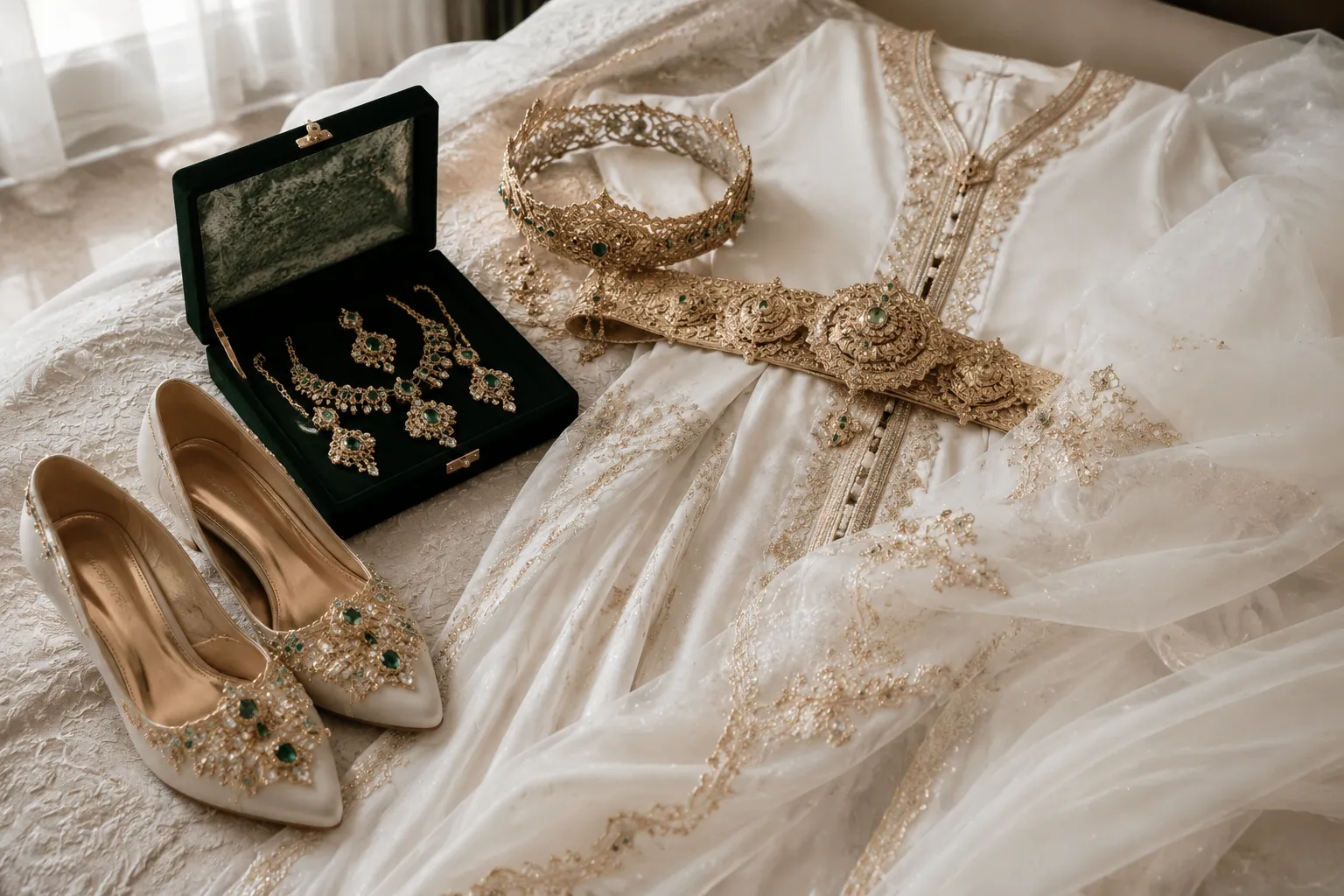
- Inventory and label garments, jewelry, belts, veils, head adornments, shoes, and storage items.
- Confirm which pieces belong to the henna night, reception, entrance, portraits, or another gathering.
- Assign one person to manage each handoff, fitting, storage point, and return.
- Allow a buffer for every outfit or accessory change.
- Complete the final check before each entrance and after the last formal appearance.
The order may vary with family preference, region, religious community, diaspora setting, venue schedule, garment construction, and styling arrangements. The timeline below is a coordination framework rather than a universal Moroccan bridal accessory timeline.
A Practical Timeline
Before the wedding: prepare each accessory set
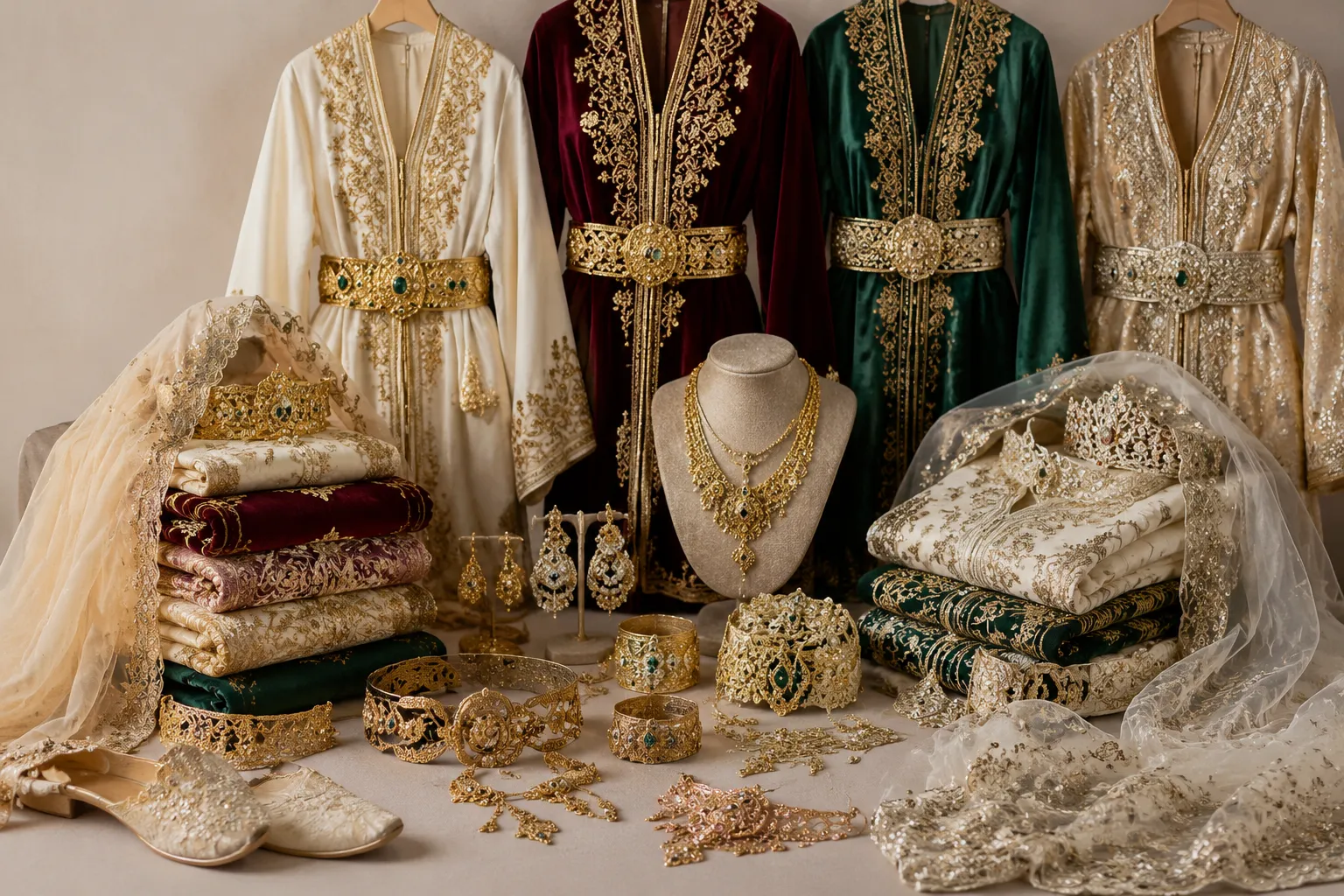
Make an inventory of every item that may be worn, carried, displayed, or photographed. A set may include:
- Caftans or takchitas
- Belts, including an ahzima where that term fits the family’s usage
- Necklaces, earrings, bracelets, rings, and other jewelry
- Veils, scarves, crowns, headbands, or hair adornments
- Shoes, handbags, pins, fasteners, garment covers, and storage pouches
- Family-owned or borrowed pieces
- Accessories reserved for the henna night, a specific entrance, or portraits
Photograph each item before packing it. Record its owner, outfit, storage location, and intended use. Numbered labels can prevent a necklace from being packed with the wrong caftan or a borrowed bracelet from being left in a preparation room.
Terminology also needs checking. A name may refer to a garment, a complete ceremonial set, a belt, or a historical practice, depending on the community and source.
Before the event: confirm custody and fitting
Choose one person to coordinate the accessories during preparation. This may be the negafa, a stylist, a trusted relative, or another person selected by the family.
That person should know which pieces belong to each outfit, which items are borrowed, which require careful handling, and whether an accessory will be worn, carried, displayed, or reserved for photographs. Name a second person for the inventory check so responsibility does not disappear during a busy change.
For borrowed or family-owned pieces, agree on the return person, storage method, and return timing in advance. A regional study from Merzouga describes clothing and silver jewelry circulating through lending by village women; that documented practice is useful context, but it should not be treated as a rule for other Moroccan weddings.
Henna night or earlier celebration: confirm the first set
Some weddings include a henna night with its own clothing and jewelry choices. The first accessory set may reflect family expectations, regional style, or the type of ceremony taking place that evening.
Research on a northern Moroccan Sephardi Jewish context uses berberisca and el-keswa el-kbira for ceremonial dress associated with the bride’s henna night. Those terms belong to that documented context and should not be presented as standard terminology for Muslim, Amazigh, urban, rural, or diaspora weddings.
Before the event, ask:
- Will the bride change accessories during the evening?
- Who places or removes the jewelry and head adornment?
- Is the headpiece fitted before the veil, or does the chosen styling use another order?
- Does the photographer need a quiet period for detail images?
- Will the outfit remain on display after the ceremony?
- Who is responsible for each family-owned piece?
A change may be ceremonial, practical, photographic, or several of these at once. The accessory alone does not establish its meaning.
Reception preparation: organize the outfit sequence
One study of a Moroccan-diaspora wedding-service setting in Europe describes successive caftans, negafa-led preparation, and final dressing shortly before the bride enters the hall. This supports one possible workflow, not a nationwide schedule.
- The negafa or styling team prepares the next garment.
- Jewelry, belt, veil, and head adornments are matched to that garment.
- The bride changes in a private preparation area.
- The stylist checks fit, fastening, comfort, and placement.
- The photographer receives the readiness cue.
- The bride enters the hall or moves to the next planned activity.
- The previous outfit and accessories return to assigned storage.
Ask the styling team for its own timing estimate. Change duration depends on fastenings, jewelry weight and placement, hairstyle, number of helpers, photography, and venue access. A short buffer is usually more useful than treating a general schedule as fixed.
Before each entrance: complete the handoff
An accessory handoff occurs when responsibility moves from one person to another. For example, a relative may bring a family necklace to the preparation room, the negafa may fit it, and the photographer may then position the bride.
Use this simple sequence:
- The current handler names the item.
- The receiving person checks it against the inventory.
- The accessory is fitted or placed.
- The bride checks comfort and movement.
- The photographer checks visibility for the planned images.
- The item is marked as worn, carried, displayed, or stored.
This role map helps distinguish a missing item from one intentionally reserved for a later outfit. Confirm the cue for each transition: a message, a coordinator’s signal, or a fixed point in the reception schedule.
After the final entrance: reconcile the set
Count the items again before the bride leaves the venue or the styling team closes the preparation area. Check jewelry trays, garment bags, dressing tables, photography areas, and transport containers.
- Return family-owned items to the named family contact.
- Separate borrowed items and record their return arrangements.
- Keep styling or rental items together according to the agreed handoff.
- Record anything not worn, changed, damaged, or moved to another person.
Who May Handle the Accessories?
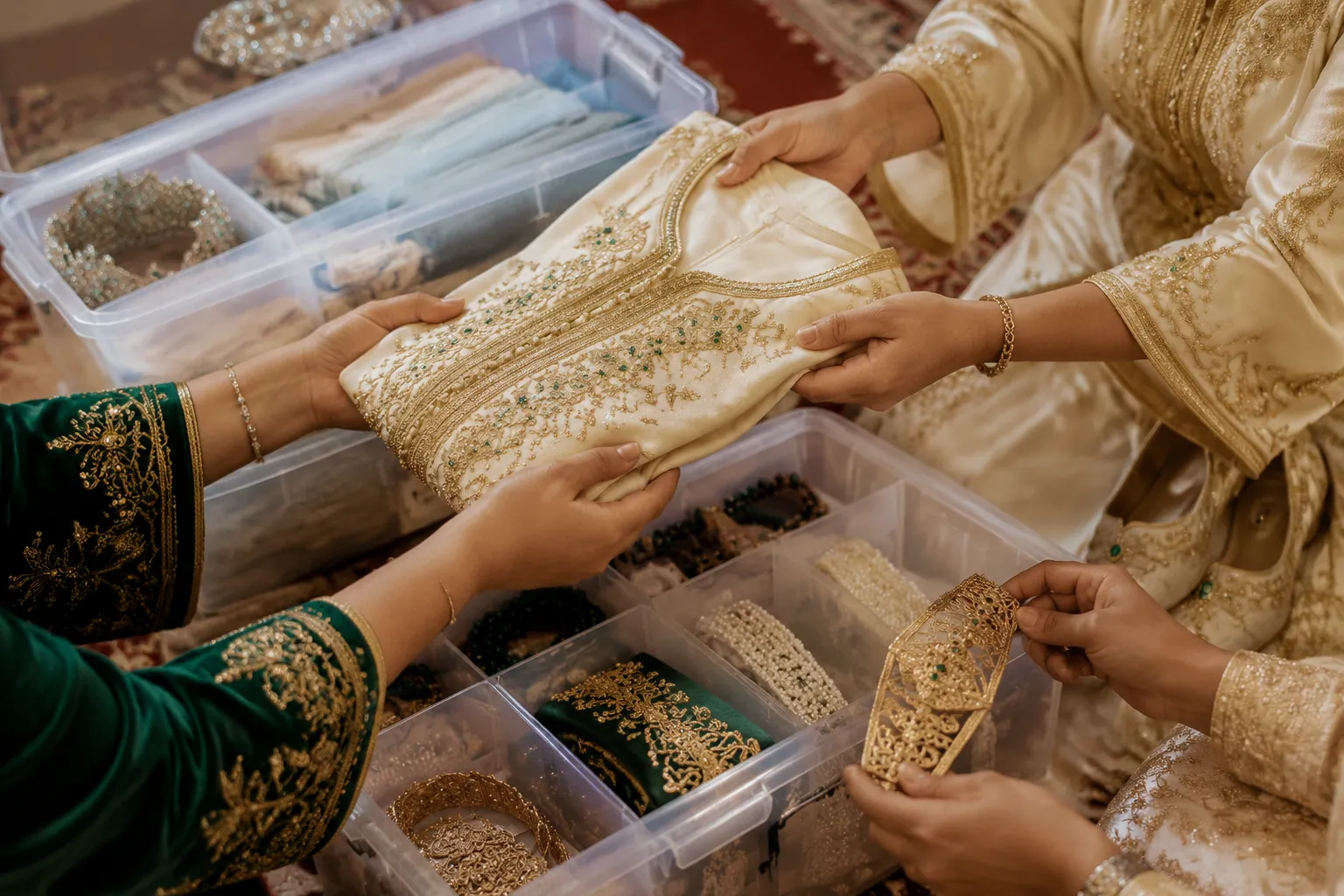
The negafa or styling team
In some contemporary wedding-service settings, the negafa coordinates garments, dressing, transitions, and preparation before the bride enters the hall. Confirm whether the same person also manages jewelry, belts, veils, and storage.
- Who fits the belt and jewelry?
- Who carries the next outfit?
- Who signals that the bride is ready?
- Does the team provide storage containers?
- What happens if a family member wants to add or remove a piece?
Family members
Relatives may bring, lend, fit, or safeguard accessories, especially when a piece has family history or belongs to someone outside the styling team. Choose one family contact for decisions so several people do not give competing instructions during a short change window.
Community-specific roles
A study of Merzouga describes isnaïns as married men appointed within that documented community’s marriage ceremonies. They may carry or present parts of the trousseau and bridal clothing during particular rituals. That role should not be assigned to another wedding without confirming the relevant community practice.
Photographer and venue team
The photographer needs to know when accessories are complete, particularly when a necklace, veil, belt, or headpiece is central to planned images. The venue team may control preparation-room access or limit the available time, so align those conditions with the change schedule.
Variation and Common Misunderstandings
Research covers different Moroccan regions, communities, historical periods, and diaspora settings. A northern Sephardi Jewish henna-night garment, a southeastern Amazigh ceremony, and a contemporary urban reception should not be merged into one standard sequence.
Regional identity may influence colors, embroidery, jewelry, garment names, and presentation. Family preference may change the order entirely. Ask what the chosen item means to this family rather than assigning meaning from a broad cultural description.
Terms such as caftan, takchita, negafa, and ahzima can also vary in use. Ask: “Which term do you use for this item, and does it refer to the garment, the complete outfit, or one accessory?”
Preparation Questions
- Which accessories belong to each outfit?
- Which pieces are for the henna night, reception, entrance, or photographs?
- Who owns each item, and which pieces are borrowed?
- Who brings each item to the venue?
- Who may fit or remove it?
- Does the belt stay with the garment or move between outfits?
- How much time is reserved for each change?
- Who gives the cue to begin?
- When should the photographer enter?
- Where are unused accessories stored?
- Who checks the inventory after each transition?
- Who returns family and borrowed pieces?
Write the answers into the schedule. Verbal assumptions are easy to lose when several celebrations and outfit changes occur on the same day.
Scope of This Timeline
Available research supports a conditional planning framework, not a fixed Moroccan bridal accessory timeline. The clearest sequence evidence comes from a specific Moroccan-diaspora service setting, while the clearest handoff evidence comes from a regional Merzouga study. Other material is historical, subgroup-specific, or focused on terminology and dress history.
The practical answer is therefore to identify each change point, assign custody, allow time, and confirm the family’s chosen order before the event. Use this script in the planning meeting:
“Please list each outfit and accessory change in order, name the person responsible for every handoff, and mark the details that reflect our family or community practice.”
Sources
- The Sephardi Berberisca Dress, Tradition and Symbology
- THREADS OF TIME Handmade Textiles for Weddings in Fez, Morocco
- Les couleurs de la mariée dans le Sud-Est marocain
- A Common Motivation—a Specific Style for Each Culture: Towards a Comparison of Wedding Rituals in Morocco
- Les isnaïns: des hommes d’honneur mis à l’épreuve
- Marriage ceremonies in Morocco
- Quatre demoiselles d'Avignon : marchandisation du mariage marocain en Europe et fin du sujet ethnique
- Motifs in Motion: Fes Belts (Ahzima) and Moroccan Design Innovation in the Mediterranean World