Moroccan Bridal Accessory Mistakes To Avoid
The most avoidable Moroccan bridal accessory mistakes happen when jewellery, headwear, belts, shoes, and borrowed pieces are treated as decoration rather than part of the wedding sequence. Before the celebration, make one shared inventory, assign responsibility for every item, match pieces to each outfit and ceremony moment, and rehearse the handoffs.
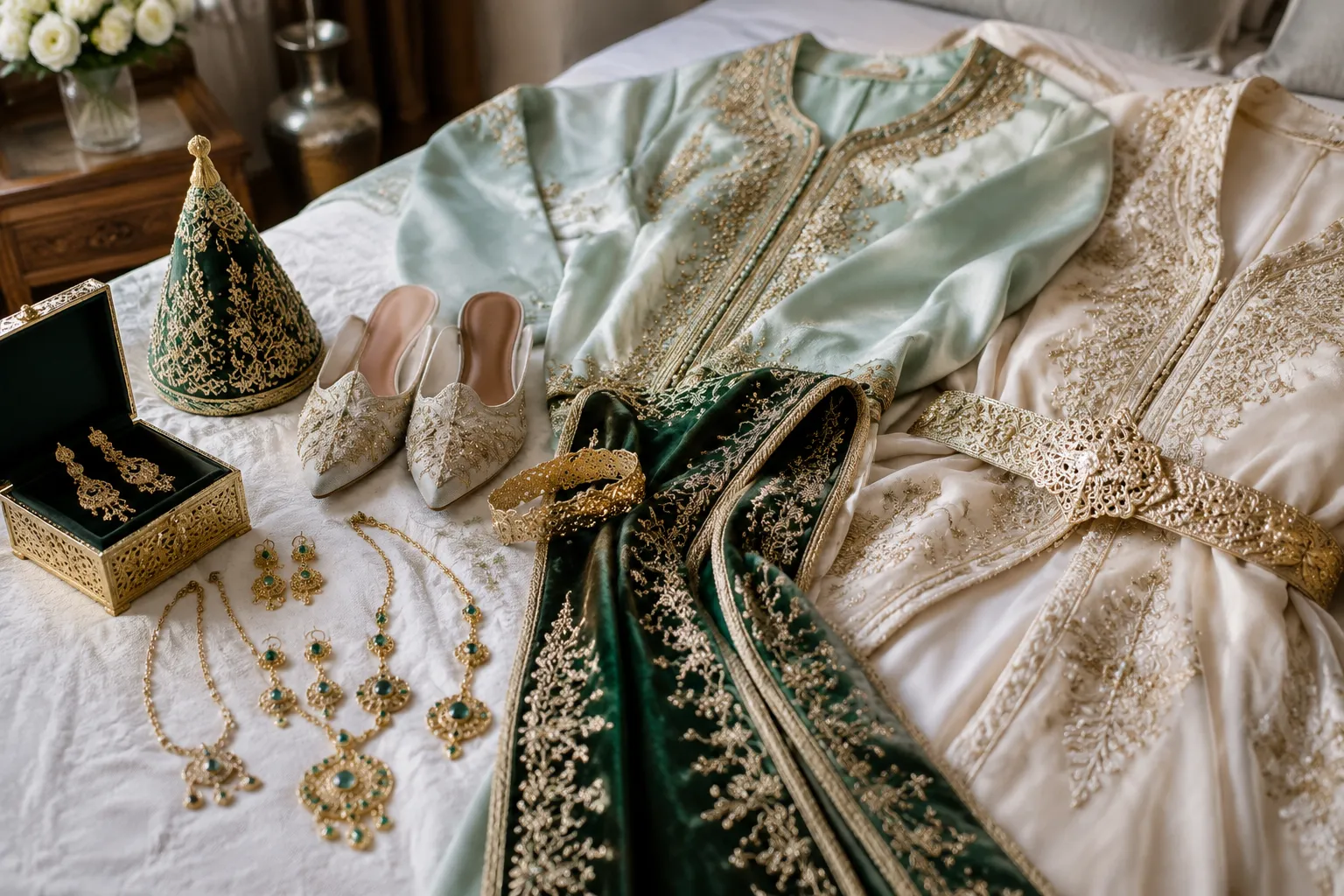
There is no single accessory pattern for all Moroccan weddings. Region, family, religious setting, community, diaspora context, venue, and celebration format can change what an item means and who handles it.
Start With One Accessory Plan
- List jewellery, headwear, belts, shoes, veils, pins, bags, inherited pieces, borrowed items, and anything supplied by a stylist.
- Record the owner or lender, the person bringing it, the handler during the event, the storage location, and the return plan.
- Match each piece to a caftan, takchita, henna-night look, entrance, portrait session, or reception transition.
- Test fit, weight, fastening, movement, and comfort with the actual garment and hairstyle.
- Confirm timing and responsibilities with the bride, family contact, negafa, stylist, venue, photographer, and relevant vendor.
Mistakes That Cause Confusion
Assuming the bride owns every accessory
A piece may be newly purchased, inherited, borrowed from a relative, rented, supplied by a stylist, or connected to a trousseau. Treating every item as the bride’s personal property can create problems when someone else must collect, present, store, or return it.
Research from the Aït Khebbach community near Merzouga describes silver jewellery and colour-linked garments circulating among women in a particular village setting. Some pieces were loaned rather than individually owned. That example does not establish a general Moroccan rule, but it shows why ownership should be clarified item by item.
- Who owns or lends this piece?
- Who may handle it?
- Should it be worn, displayed, carried, or presented?
- Who takes it home after the celebration?
Turning one regional style into a national requirement
A colour, jewellery form, head covering, belt, or presentation order may matter in one community without applying to another. Material from Merzouga documents a specific ceremonial setting involving white clothing, a red veil, and silver jewellery. Other studies describe different preparation roles and ceremony structures.
Use regional examples to identify variation, not to prescribe an accessory list. Ask whether a detail belongs to the family or community, relates to a particular region or ceremony, or has simply been inferred from a catalogue.
Buying accessories before matching the outfits
A necklace, belt, crown, or headpiece can look suitable alone and still conflict with a caftan or takchita neckline, embroidery, sleeves, veil, hairstyle, or movement. Review accessories after the outfit sequence is reasonably settled.
For each look, note the garment, waist detail, headwear, earrings, necklace, bracelets, rings, shoes, hairstyle, spare pins, and pieces that must be removed before the next change. Include the negafa or stylist in this review: confirm which items they place, which pieces the family provides, and which fastening method each item needs.
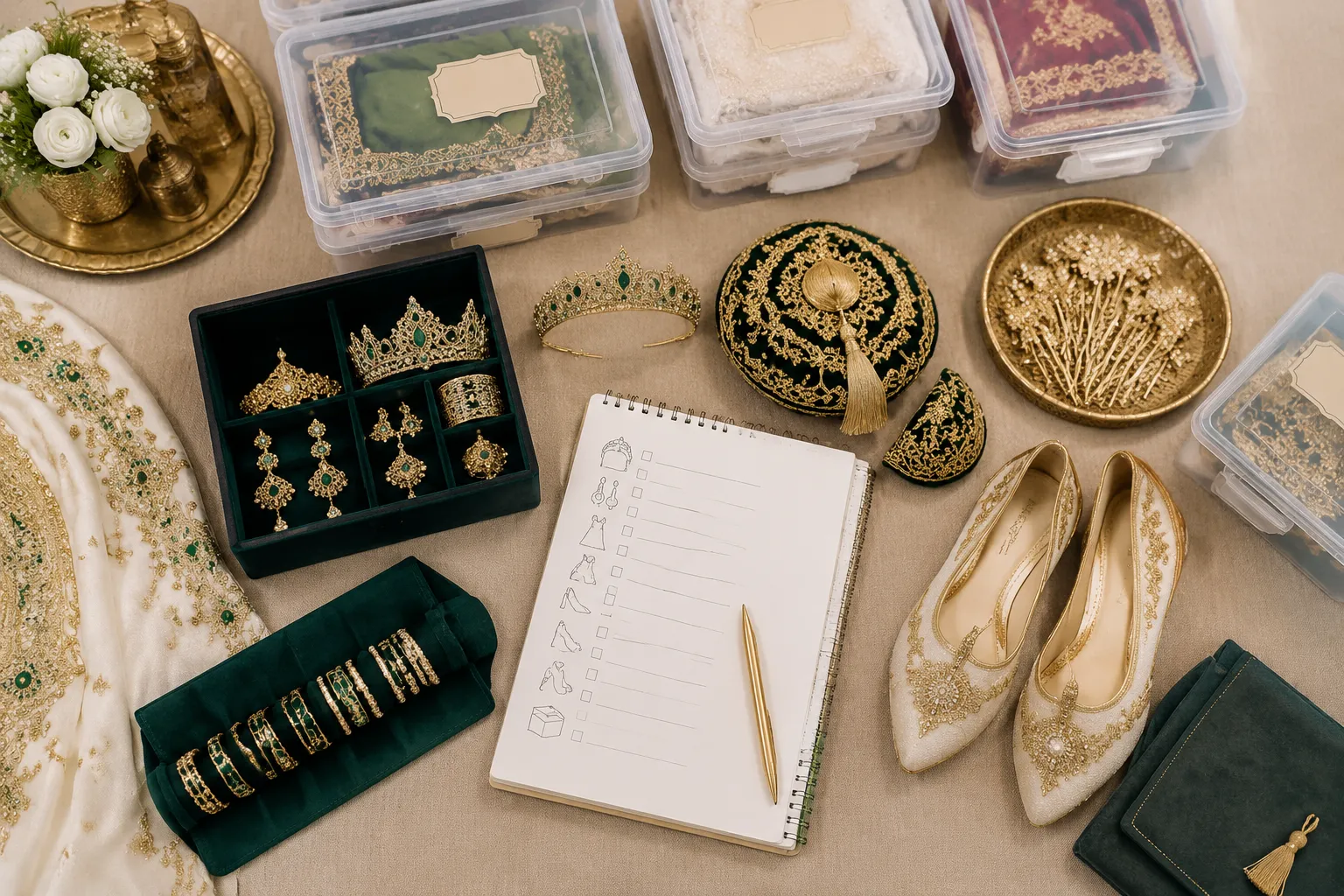
Leaving outfit-change handoffs to memory
During a change, an accessory may move from the dressing room to the next outfit, stage area, portrait location, or storage case. The bride may be changing clothes, greeting relatives, and preparing for photographs at the same time.
| Event point | Accessory task | Named responsibility |
|---|---|---|
| Before guests arrive | Count and check the inventory | Designated family member or stylist |
| First outfit | Place and secure the pieces | Bride and styling team |
| Outfit change | Remove, label, and store items | Assigned handler |
| Entrance or presentation | Carry or position the required pieces | Confirmed family or vendor contact |
| Portraits | Keep selected items together | Photographer’s point person |
| End of event | Pack, count, and return pieces | Owner or designated relative |
Checking appearance but not movement
Try significant accessories with the actual garment and hairstyle. Have the bride walk, sit, stand, turn her head, lift her arms, enter the planned seating area, and wear the pieces for a rehearsal period.
Check for catching on embroidery, pressure around the neck, shifting, interference with the veil, or repeated adjustment. For inherited or borrowed pieces, inspect the fastening and agree on a storage method. Do not alter an important item without the owner’s permission.
Confusing display with wear
Some accessories may be worn by the bride. Others may be carried, presented with trousseau items, displayed near the seating area, or shown during a family moment. A location-specific Merzouga study describes jewellery and garments being presented as part of ceremonial preparation, which makes the distinction useful beyond that example.
Write the intended use beside every item:
- Worn by the bride
- Worn briefly for photographs
- Carried during an entrance
- Presented with gifts or trousseau items
- Displayed near the seating area
- Kept with the family throughout the celebration
Assuming the vendor knows the family details
A negafa, stylist, jewellery provider, venue, photographer, or event coordinator may control one part of the accessory sequence. Their responsibilities need to be agreed rather than inferred.
Send one concise accessory brief with outfit combinations, arrival and dressing times, borrowed or sensitive pieces, storage instructions, family handoffs, portrait priorities, items that must not be altered, and the contact person for last-minute decisions.
- Which accessories will you handle?
- Where will items be stored during outfit changes?
- Who cues the bride when the next piece is needed?
- Can the planned accessories work with the venue layout and entrance?
- Which items need dedicated portraits?
- What is the agreed response if an item arrives late or cannot be used?
A vendor’s proposed sequence is a planning suggestion. Family preferences and the people responsible for borrowed or inherited pieces still need to be included.
Check Timing Before the Event
Accessories can affect the length of an outfit change, the order of portraits, and the timing of an entrance. A headpiece may need careful placement, while a family member may need to arrive with a particular item before dressing begins.
Confirm when each accessory arrives, when it is checked, when it is worn, whether it appears before or after the entrance, whether it is used for the ceremony or photographs, how long removal and storage take, and who gives the cue for the next change.
The sequence may differ between a henna night, reception, family gathering, and celebration with an amariya entrance. Research on Moroccan wedding rituals describes variation in ceremony structure, location, actions, and timing, so confirm the order for this celebration rather than importing one from another wedding.
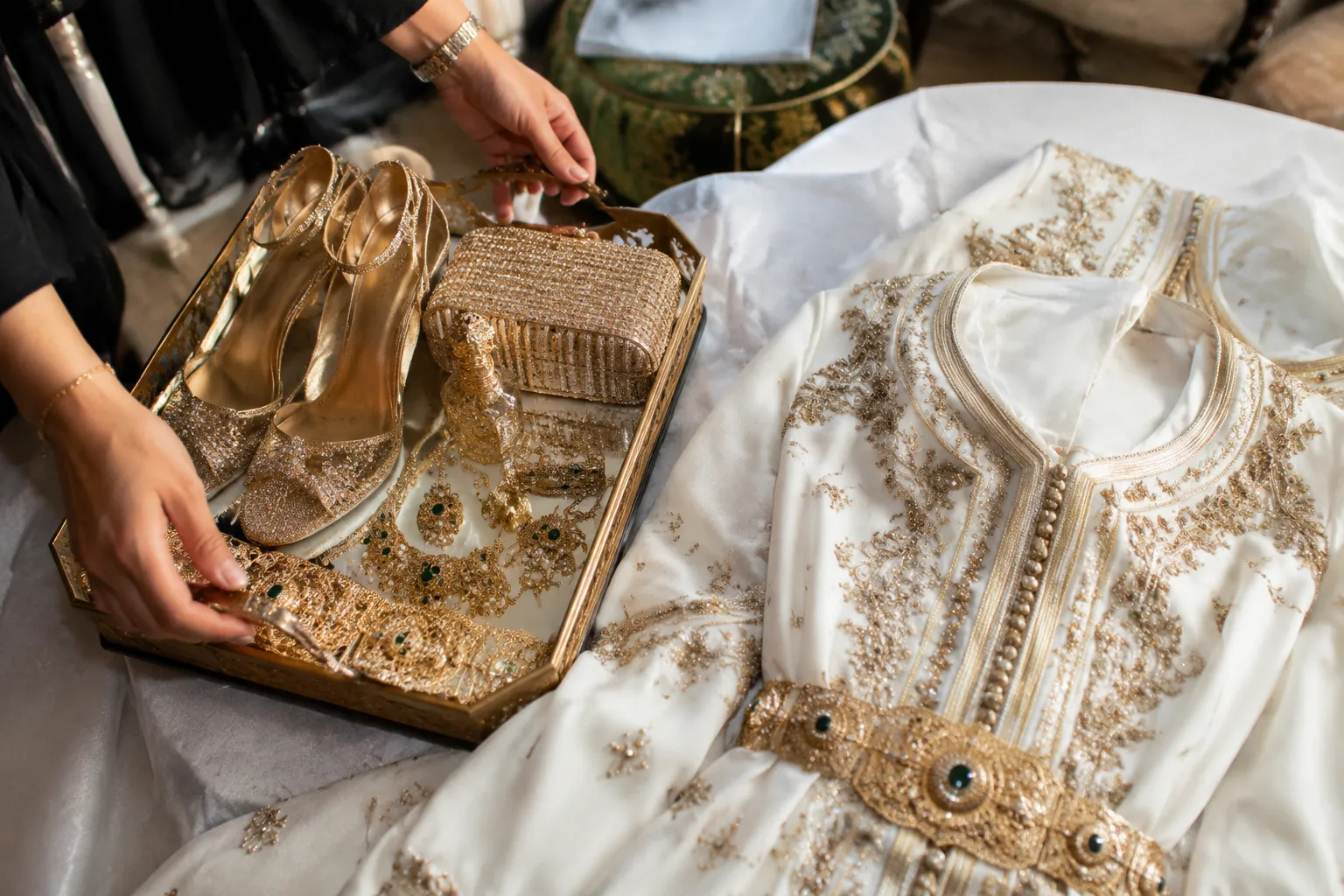
Final Accessory Check
- Every item has an owner or lender and a named handler.
- Each piece is matched to an outfit or ceremony moment.
- Borrowed and inherited accessories are clearly identified.
- The bride has tried the pieces with the actual garments and hairstyle.
- Fastenings, pins, cases, and labels are ready.
- Outfit-change timing includes removal and storage.
- The negafa or stylist has the current sequence.
- The venue knows about entrances, display areas, and storage needs.
- The photographer knows which accessories are meaningful or family-specific.
- Family expectations and the return plan are written down.
The useful question is specific: who handles this accessory, at what moment, for which outfit or ceremony purpose, and according to whose family or community expectation?
The available academic material supports attention to circulation, presentation, preparation roles, adornment, and local variation. It does not establish a universal Moroccan accessory order or current vendor practice. Use it to identify questions, then confirm the final handoff with the people responsible for this celebration.
Sources
- A Moroccan wedding ceremony between tradition and modernity: the role of women in the preparations
- A Common Motivation—a Specific Style for Each Culture: Towards a Comparison of Wedding Rituals in Morocco
- Moroccan wedding colours and jewellery in Merzouga
- Moroccan wedding ceremonies and the role of the isnaïns in Merzouga
- Jewish North African head adornment: Traditions and Transition
- Tracing Trade and Settlement Infrastructures in the Judaic Material Culture of Tafilalt, Southeastern Morocco