Moroccan Bridal Belt Mdamma Styling Guide
Plan the Moroccan bridal belt mdamma with the full bridal outfit, then confirm its placement, adjustment, comfort, jewelry balance, and handoff before the bride enters. The belt may accompany a caftan, takchita, or another formal layer, depending on the outfit, family preference, and styling plan.
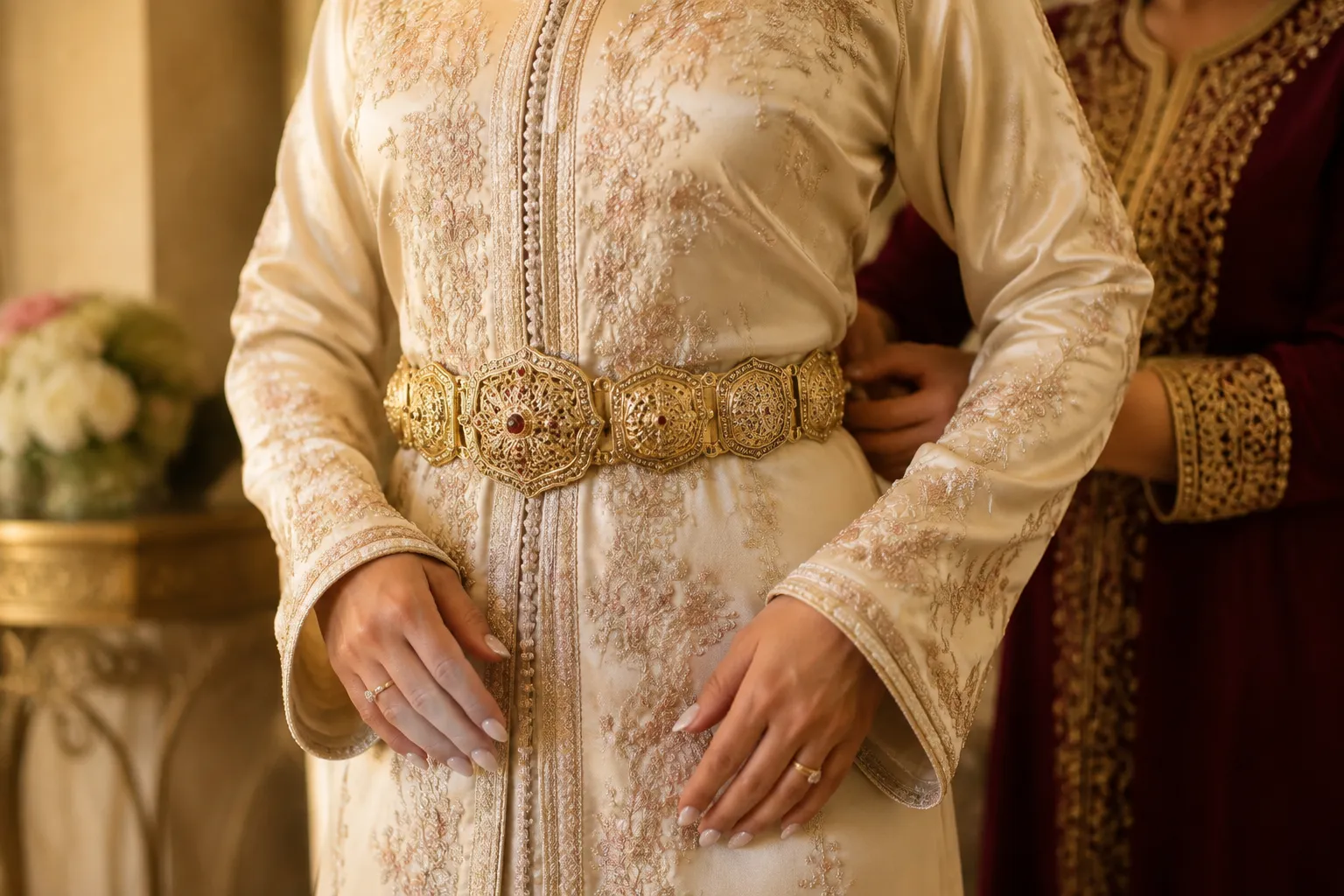
There is no single current sequence or fastening method for every Moroccan wedding. Available research describes belt forms, changing fashion, bridal-dressing coordination, and regional or diaspora variation, but it does not establish one universal fit standard or family expectation.
Plan the Mdamma With the Outfit
Start with the garment that will be worn when the belt appears. Lay out the clothing, mdamma, jewelry, shoes, veil or head covering if applicable, and any outer layer that may affect the waist area.
- Check the garment’s waistline, side openings, and fabric thickness.
- Note where embroidery, trim, or decorative closures will sit.
- Review the belt with the jewelry planned for that outfit change.
- Decide whether the same belt will be used with more than one garment.
- Test whether the belt stays in position while the bride sits, walks, and raises her arms.
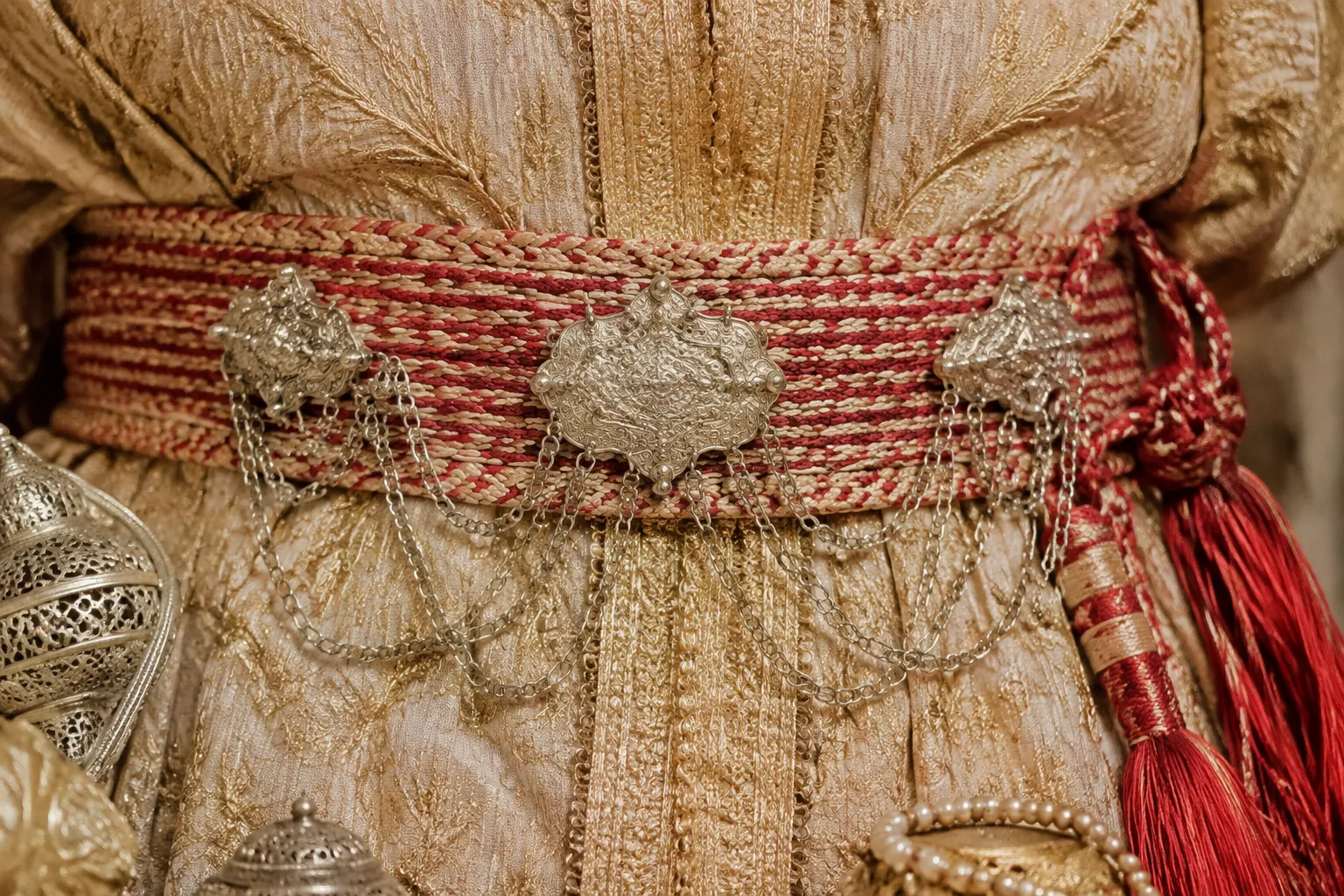
Material-culture research describes Moroccan belts with varied wrapped, braided, woven, and decorative elements. These descriptions help explain why pieces differ, but they do not prove that every contemporary bridal mdamma uses the same construction or closure.
A Practical Styling Sequence
Use the following as a coordination framework. Confirm each handoff with the person responsible for the outfit rather than assuming a standard order.
Choose the Outfit Change
Identify the exact look and moment when the mdamma will be worn. Record the garment, expected entrance or photography cue, assigned jewelry, dressing person, adjustment time, and whether the belt is removed before the next change.
The order may differ between a wedding held in Morocco and a Moroccan-diaspora celebration. It may also differ between families working with a negafa and families managing the clothing themselves.
Review the Visual Pairing
Place the belt over the actual garment instead of judging it against a fabric swatch. Check whether its width, texture, and motifs support the embroidery and leave important details visible.
- Does it define the waist without covering the garment’s main details?
- Does it balance the necklace, bracelets, earrings, or head adornment?
- Does it suit the family, regional, or personal styling direction?
- Will it remain visible in seated portraits and entrance photographs?
Confirm the Placement
Decide where the belt should sit during the final dressing appointment. A familiar waist position may not work equally well over every garment layer or silhouette.
The bride, stylist, or negafa should check the intended height, coverage of embroidery or closures, stability during movement, and whether the position needs to change for photographs. Treat placement as an outfit decision, not a universal rule.
Assign the Fastening Handoff
Clarify who will put on, close, tighten, loosen, and remove the belt. The negafa, stylist, family member, or another dressing person may handle different parts of this process.
Ask the person responsible to demonstrate the planned adjustment with the actual garment layers. The available research does not verify one nationwide fastening technique, so the selected piece and outfit should determine the practical arrangement.
Check Comfort and Movement
Allow the bride to test the belt while standing, sitting, walking, greeting guests, and preparing for photographs. Check breathing comfort, pressure over seams or closures, stability, and ease of removal during the next outfit change.
Complete the first movement check before the entrance window. A final adjustment may still happen later, but an earlier test leaves time to change the placement or sequence.
Coordinate the Photography Cue
Tell the photographer when the belt is fully adjusted and the jewelry is in place. Family portraits, waist-detail images, seated photographs, and entrance images may require different views or temporary repositioning.
The negafa may coordinate clothing, jewelry, relatives, vendors, and movement between ceremony stages. The mdamma is therefore one handoff within the wider outfit-change sequence.
Who Needs to Be Included?
- The bride: Approves the garment pairing, height, tightness, visibility, comfort, and final appearance. She can also decide whether the belt should be a focal point or a quieter part of the look.
- The family: May have preferences concerning an inherited belt, regional identity, colors, jewelry, relatives present during dressing, or the order of outfit changes. Discuss these preferences directly rather than treating them as shared by all Moroccan families.
- The negafa or stylist: Confirms who brings the belt, checks its fit, makes the final adjustment, allows dressing time, and removes it later.
- The photographer: Needs the timing for full-length, waist-detail, seated, family, and entrance photographs.
- The venue team: Can help confirm the private dressing area, route to the reception space, available time, seating, and entrance signal.
Assign approval, fastening, photography, and timing separately. One person may handle several tasks, but each responsibility should have a named handoff.
Pairing the Mdamma With Garments and Jewelry
Caftan
Check whether the belt supports the caftan’s central shape or covers important embroidery. A heavily embellished garment may call for a quieter arrangement, while a simpler waist area may allow more visible belt detail.
Takchita
Review every layer before fastening. The belt may sit over one layer, several layers, or a designated waist area, depending on the construction and the stylist’s plan.
- Is the outer layer meant to remain open?
- Does the belt close over the full outfit?
- Will it be removed before another layer is added?
- Will fastening hide jewelry, trim, or closures?
Jewelry and Photography
Review the belt and jewelry as one arrangement. Photograph the outfit from the front and a three-quarter angle, then check the waist and neckline together under the venue’s expected lighting.
Avoid assigning fixed meanings to particular motifs or colors without information specific to the bride’s family or region. Research on Moroccan dress and craft classification describes historical documentation, regional labels, changing fashion, and later representations, so a label alone does not establish one fixed interpretation.
Final Fitting Checklist
- Outfit: Which garment and layers will accompany the mdamma? Will it cover embroidery, trim, or closures? Is it intended for one look or several?
- Placement: Where should it sit? Has that position been tested on the actual outfit?
- Adjustment: Who will fasten, loosen, adjust, and remove it?
- Movement: Has the bride walked, sat, stood, greeted guests, and posed while wearing it?
- Timing: Is there time for a second adjustment before photographs or the entrance?
- Coordination: Has the family seen the pairing? Does the photographer know when the look is ready? Who gives the entrance cue?
- Variation: Is the look based on a family preference, regional influence, inherited piece, borrowed item, rental, or contemporary choice?
Common Planning Misunderstandings
Assuming every mdamma fastens the same way
Belt forms and workmanship vary. Ask the stylist or negafa to show the exact adjustment method for the selected piece.
Turning a regional example into a national rule
Fez observations and diaspora accounts describe particular settings. They can illuminate variation, but they should not dictate every Moroccan wedding.
Choosing the belt before the garment
A belt can look balanced by itself and become unsuitable over actual embroidery, layers, or jewelry. Review the complete outfit before confirming the choice.
Leaving movement checks until the entrance
Test sitting and walking earlier, then reserve the entrance window for a final placement check and cue.
Confirmation Script
“For the mdamma look, which garment and layers will it accompany? Where should it sit, who will fasten and remove it, and when will the bride test walking and sitting? Please also confirm the jewelry pairing, family preferences, photography cue, and person responsible for the final adjustment.”
For a family-specific or regional look, add: “Are there inherited, regional, or family details we should preserve, and which parts are personal styling choices rather than fixed expectations?”
What the Available Sources Establish
Research on Moroccan belts and textiles provides context about waist placement, varied construction, woven workmanship, motifs, and changing fashion. Studies of wedding preparation and bridal coordination support viewing dressing as a sequence involving clothing, jewelry, timing, relatives, vendors, and ceremony transitions.
The available material does not establish one current nationwide styling procedure, fastening method, compatible garment layer, placement standard, or required family role. Use the actual belt, the bride’s outfit, family preferences, and the stylist’s schedule to settle those details before the entrance.
Sources
- Motifs in Motion: Fes Belts (Ahzima) and Moroccan Design Innovation in the Mediterranean World
- Trimmings in Fez Morocco
- A Moroccan wedding ceremony between tradition and modernity: the role of women in the preparations
- Quatre demoiselles d’Avignon: marchandisation du mariage marocain en Europe et fin du sujet ethnique
- Of texts and textiles …: colonial ethnography and contemporary Moroccan material heritage